




Open vs. Closed Rhinoplasty: Which is Better
Open vs. Closed Rhinoplasty: Which is Better
Deciding to reshape your nose is not just about appearance; it’s about how you feel in your own skin. Whether you’re hoping to breathe more comfortably, restore balance after an injury, or feel more confident in your reflection, rhinoplasty can be a meaningful step forward.
One of the most common concerns patients have is understanding Open vs. Closed Rhinoplasty. Getting to know which approach truly serves your goals best.
While both techniques are effective, modern surgical trends and rhinoplasty experts like Dr Levente Deak increasingly lean toward open rhinoplasty for its precision, stability, and long-term outcomes.
What is Open Rhinoplasty and Closed Rhinoplasty?
Before diving into comparisons, it helps to understand the foundation of both techniques.
Open Rhinoplasty
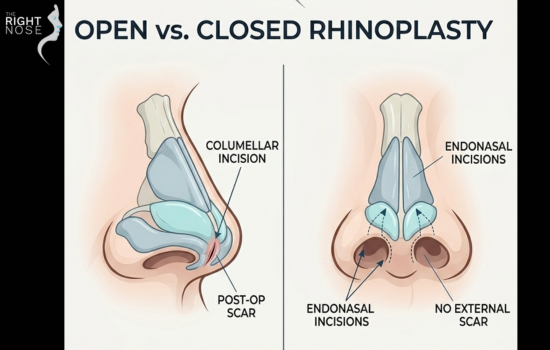
Open rhinoplasty involves a small incision at the base of the nose (between the nostrils), allowing the surgeon to gently lift the skin and access the nasal structures directly. This approach provides a clear and detailed view of the anatomy.
Closed Rhinoplasty
Closed rhinoplasty is performed using incisions placed inside the nostrils. This avoids any visible external cuts. It is typically used for minor refinements where extensive reshaping is not required.
Open vs Closed Rhinoplasty: How Open Rhinoplasty has an edge?
Parameter | Open Rhinoplasty | Closed Rhinoplasty |
Surgical Access | Full, direct visibility of structures | Limited visibility |
Precision | Highly precise, controlled reshaping | Suitable for minor changes |
Structural Stability | Stronger, long-term structural support | Moderate |
Revision Rate | Lower (less than 5%) | Slightly higher |
Tip Refinement | Excellent control, especially for complex tips | Restricted access |
Suitability | Simple to highly complex cases | Minor corrections |
Scarring | Small scars | Minimal, fades significantly |
Surgery Time | Slightly longer but more thorough | Shorter |
Swelling | Mild | Mild |
Long-Term Results | More predictable and stable outcomes | Good for subtle changes |
This comparison highlights why open rhinoplasty is often considered the more reliable and versatile technique today.
Why Open Rhinoplasty is often the better choice?
In modern practice, the question is less about open vs closed rhinoplasty and more about which approach delivers consistent, long-term results.
Open rhinoplasty stands out because:
- It allows complete visualization of the nasal framework
- It enables accurate cartilage shaping and placement
- It provides greater control over symmetry and proportions
- It reduces the likelihood of unexpected irregularities
For patients asking about open or closed rhinoplasty for bulbous tip, the answer is clear, open rhinoplasty offers the precision required to sculpt and refine the nasal tip effectively.
Benefits and Risks
Open Rhinoplasty
Open rhinoplasty has become the preferred technique for many surgeons due to its reliability and outcomes.
Key advantages:
- Superior precision and control
Every structural change is made under direct vision. - Lower revision rates
Studies suggest revision rates are less than 5% when performed by experienced surgeons. - Better long-term stability
Structural support techniques help maintain results over time. - Ideal for complex and revision cases
Especially useful when correcting asymmetry or previous surgical outcomes. - Improved tip definition
Particularly beneficial for thick skin or bulbous nasal tips.
Did you know? |
Risks of Open Rhinoplasty
Few risks which are minimal and manageable with proper surgical technique and aftercare:
- Temporary swelling, especially at the nasal tip
- Slightly longer recovery period
- A small external scar (usually heals to near invisibility)
Closed Rhinoplasty
Benefits of Closed Rhinoplasty
Closed rhinoplasty is suitable for minor adjustments with key advantages like shorter surgery time, faster early recovery. Patients often explore closed rhinoplasty before and after results for subtle refinements, such as smoothing a small hump.
Risks of Closed Rhinoplasty
However, limitations can impact outcomes:
- Restricted visibility for the surgeon
- Less control over complex reshaping
- Higher likelihood of revision in certain cases
- Limited effectiveness for tip refinement
Open vs Closed Rhinoplasty recovery
Recovery is an important factor in decision-making.
Open Rhinoplasty recovery | Closed Rhinoplasty recovery |
|
|
While closed vs open rhinoplasty recovery differs in the short term, open rhinoplasty often provides more predictable long-term outcomes, making the extra healing time worthwhile for many patients.
Why Dr Levente Deak prefers Open Rhinoplasty?
Dr Levente Deak strongly prefers open rhinoplasty for its precision, control, and reliability.
His approach is centered on:
- Detailed anatomical assessment before surgery
- Direct visualization for accurate correction
- Structural reinforcement techniques for long-lasting support
- Minimizing revision rates through meticulous planning
With extensive experience in advanced rhinoplasty techniques, Dr Levente specialises in achieving results that are not only aesthetically pleasing but also structurally sound. His preference for open rhinoplasty stems from its ability to deliver consistent, predictable, and stable outcomes, especially in complex or high-expectation cases.
Open vs Closed Rhinoplasty: Final Verdict
If you’re still debating between open and closed rhinoplasty, the answer is usually in favor of open rhinoplasty, especially when long-term stability, accuracy, and symmetry are important considerations.
For little adjustments, closed rhinoplasty is effective; but, in most cases, open rhinoplasty offers a degree of control that greatly improves outcomes.
Choose Confidence, Choose Clarity with Open Rhinoplasty at Dr Levente Deak’s
Rhinoplasty is a balancing act between form, function, and confidence rather than just a cosmetic treatment. Both methods have their uses, but open rhinoplasty provides a degree of accuracy and dependability consistent with contemporary surgical norms.
With a strong emphasis on attaining natural, long-lasting outcomes, you may feel secure knowing that your treatment plan is customized to your specific needs under the knowledgeable direction of Dr Levente Deak.
Schedule your consultation today.
Discover how a carefully planned, expertly performed rhinoplasty can make all the difference!
Some Quick FAQs
Open rhinoplasty is often preferred for its precision, better control, and lower revision rates, especially in complex cases.
Because the surgeon can clearly see and adjust the nasal framework, leading to more accurate and stable results.
The scar is very small and usually fades well, becoming barely visible over time.
Open rhinoplasty is generally the better choice as it allows detailed reshaping of the nasal tip.
Closed rhinoplasty heals a bit faster initially, but open rhinoplasty offers more refined results as healing progresses.
Yes, the results are typically long-term due to improved structural support and precise correction.
Yes, but these are usually best suited for minor changes rather than complex reshaping.
It works for most cases, especially when detailed correction or structural improvement is needed.

Meet the Author
Dr. Levente Deak is a European Board-Certified ENT Surgeon and a USA and EU Dual Board-Certified Facial Plastic Surgeon based in Dubai. With over 20 years of surgical experience focused exclusively on the face, he specialises in rhinoplasty, blepharoplasty, facial rejuvenation, and nasal airway correction. An active member of the Royal College of Surgeons and the European Academy of Facial Plastic Surgery (EAFPS), Dr. Levente is known for his precision-driven, minimally invasive approach. His guiding philosophy, that every nose must be tailored to the individual, shapes every procedure he performs at The Right Nose clinic.
Medical Disclaimer
The content on this blog is for informational purposes only and does not constitute medical advice, diagnosis, or treatment. Individual results may vary. Always consult Dr. Levente Deak or a qualified healthcare provider before pursuing any surgical or non-surgical procedure.