






What is the best age to get a facelift
What is the best age to get a facelift -Dr Levente Deak
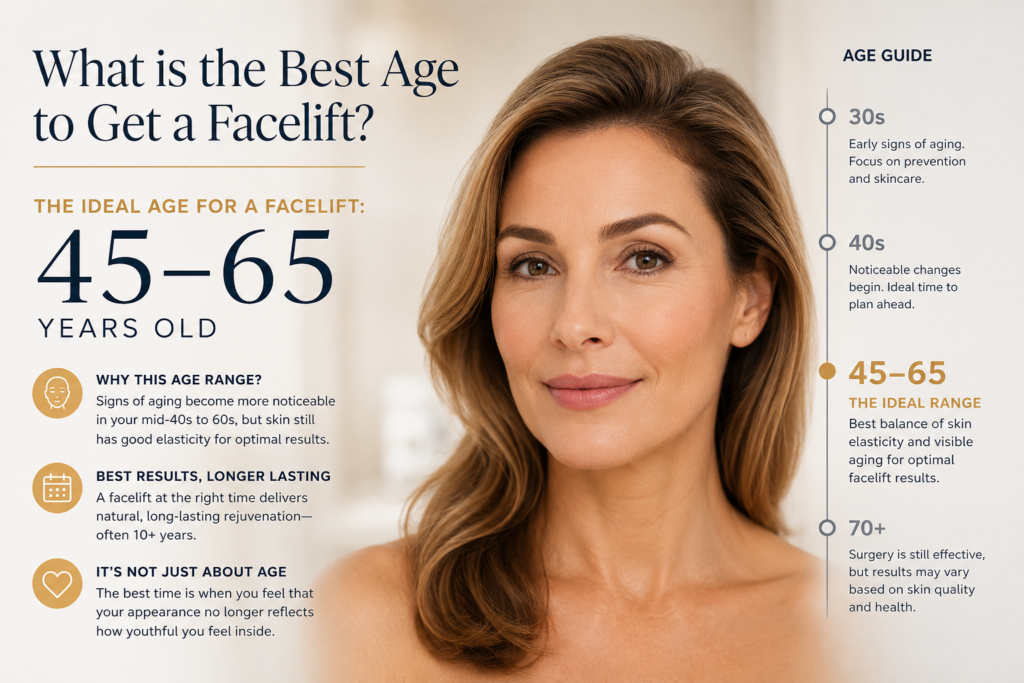
Ageing affects every face differently. While some people notice early skin laxity in their forties, others maintain firm facial contours well into their sixties. This is why one of the most common questions patients ask is: What is the best age to get a facelift?
‘Age is not the only factor to decide a facelift’
Modern facelift surgery focuses on structural rejuvenation rather than creating an artificial appearance. The aim is subtle enhancement that preserves facial movement and individuality.
At The Right Nose by Dr Levente Deak, facial rejuvenation is approached with precision, balance, and a deep understanding of facial anatomy to achieve elegant, natural-looking outcomes.
Are you noticing the early s, ideal age for a faceliftigns of ageing or exploring long-term facial rejuvenation options? Understand the ideal age for a facelift and make a confident decision.
What is a facelift?
Before discussing what is the best age to get a facelift, it is important to understand what is a facelift and how modern techniques differ from outdated perceptions.
A facelift or rhytidectomy, is a surgical procedure designed to improve visible signs of ageing in the lower face and neck. Rather than simply tightening the skin, contemporary facelift techniques reposition deeper facial tissues to restore youthful contours more naturally.
What are the common concerns addressed with a facelift?
Sagging skin around the cheeks and jawline | Jowls | Deep folds around the mouth and nose | Loss of jawline definition | Loose skin beneath the chin | Neck laxity |
It is also important to understand what a facelift does not primarily treat. Concerns such as skin texture, pigmentation and very fine lines may require additional skin rejuvenation treatments for optimal results.
Facial ageing is about more than age alone
One of the reasons there is no fixed answer to what is the best age for a woman to get a facelift is because facial ageing affects everyone differently.
Two people of the same age can show completely different levels of skin laxity, facial volume loss, and tissue descent. This is why experienced facial plastic surgeons often focus more on biological ageing than chronological age.
What are the factors that influence the facial ageing?
- Genetics
- Sun exposure
- Smoking
- Stress
- Weight fluctuations
- Hormonal changes
- Collagen loss
- Skin quality and elasticity
What is the average age for a facelift?
Facelift is not only about the age, Dr Levente Deak will assThe average age for a facelift generally falls between the late 40s and mid 50s.
This is often the stage when:
- Facial sagging becomes more noticeable
- Jawline definition softens
- Neck laxity develops
- Non-surgical treatments may no longer provide sufficient improvement
There’s ‘no perfect’ age for facelift that applies to everyone. Some individuals seek subtle rejuvenation in the early stage while others benefit from facelift surgery depending on their facial structure, skin quality, and personal goals.
What is the best age to get a facelift?
The ideal age for a facelift depends less on age itself and more on when facial ageing begins affecting confidence, facial balance, and the effectiveness of non-surgical treatments.
In your 40s: Early facial ageing and preventative rejuvenation
For many patients, the 40s mark the beginning of visible structural ageing.
Patients at this stage often show mild to moderate sagging and volume loss. A less invasive option such as an endoscopic or mini facelift may deliver excellent results with a quicker recovery and longer runway before further intervention is needed.
For some individuals, this can represent the ideal age for a facelift, particularly when injectable treatments no longer achieve the desired improvement.
In your 50s: The most common time for facelift surgery
This is the most common window and widely regarded as the average age for a facelift. Facial ageing is visible but the tissues are still reasonably robust, healing is good, and the results tend to be particularly long-lasting.
This is also the age range many patients refer to when researching what is the best age for a woman to get a facelift.
In your 60s and beyond: Is it ever too late?
Many patients worry they may be “too old” for facelift surgery. In reality, healthy older individuals can still achieve elegant and rewarding outcomes.
A full or deep plane facelift is often the most appropriate choice for more advanced signs of ageing. Modern facelift surgery can restore facial definition and improve sagging without compromising natural expression or individuality.
Signs you may be ready for a facelift
Rather than fixating on a specific number, here are the signs that suggest you’re a good facelift candidate:
- You notice jowling or skin laxity that no filler or skincare routine addresses
- Your neck skin has begun to sag or develop banding
- Your jawline has lost definition
- Non-surgical treatments are no longer giving you satisfying results
- You’re in good general health with realistic expectations
- You’re emotionally prepared for a surgical process and recovery period
Patients often begin searching what is the best age to get a facelift when these signs become difficult to improve non-surgically.
Facelift vs non-surgical treatments: Which is right for you?
Non-surgical aesthetic treatments can be highly effective during earlier stages of ageing by improving fine lines and mild volume loss.
Non-surgical treatments include:
- Dermal fillers
- Anti-wrinkle injections
- Skin tightening treatments
- Medical-grade skincare
However, once facial tissues begin to descend structurally, surgery often provides more effective and longer-lasting rejuvenation.
Why do patients combine a facelift with other facial procedures?
Facial ageing rarely affects just one area of the face. While a facelift improves sagging in the lower face and neck, some patients benefit from combining procedures for more harmonious facial rejuvenation.
Based on the individual concerns, facelift surgery may sometimes be combined with:
- Blepharoplasty (eyelid surgery) – to reduce heaviness around the eyes
- Brow lift procedures – to improve forehead descent and restore a refreshed appearance
- Fat grafting -to naturally restore lost facial volume
- Neck lift surgery – to improve jawline and neck definition
- Skin rejuvenation treatments – to address texture and pigmentation concerns
The purpose of combination treatment is not to create dramatic change. Instead, it helps achieve better balance between facial regions while maintaining natural facial expression.
At Dr Levente Deak’s practice, facial rejuvenation procedures are tailored carefully to each patient’s facial structure, ageing pattern, and long-term goals.
How long does a facelift last?
Although the natural ageing process continues, facelift results are generally long-lasting. Most patients enjoy visible rejuvenation for approximately 10–15 years depending on several factors, including:
- Surgical technique
- Skin quality
- Lifestyle habits
- Smoking
- Sun exposure
- Weight stability
- Ongoing skincare
A facelift does not stop ageing, but it can effectively reposition facial tissues and restore youthful contours that continue to age naturally over time.
Why natural facial harmony matters?
At The Right Nose by Dr. Levente Deak, facial procedures are approached with precision and attention to harmony rather than exaggerated transformation. Every treatment plan is personalised according to facial anatomy, skin quality, and aesthetic goals.
This refined approach helps patients achieve rejuvenation that appears elegant, balanced, and authentic.
Why should you choose Dr Levente Deak for a facelift?
- Extensive experience in facial plastic surgery and facial rejuvenation procedures
- Focus on natural-looking results that complement individual facial features
- Personalised treatment planning based on facial anatomy and ageing patterns
- Advanced techniques designed to restore youthful facial structure with precision
Conclusion: The best age for a facelift is different for everyone
So, what is the best age to get a facelift?
There is no single answer. The ideal age for a facelift depends on facial anatomy, skin quality, lifestyle factors, and the degree of visible ageing rather than age alone.
While the average age for a facelift often falls between the forties and fifties, many patients benefit from facial rejuvenation both earlier and later in life.
Considering facial rejuvenation surgery? Book a personalised consultation with Dr Levente Deak and choose a treatment designed around your facial structure, ageing concerns, and aesthetic goal
Some Quick FAQs
There’s no perfect age for a facelift. Most people consider it when facial sagging or skin laxity becomes noticeable or when the non-surgical treatment no longer provide results.
A facelift primarily improves sagging skin, jowls, neck laxity, and loss of jawline definition by repositioning deeper facial tissues.
The average age for a facelift is typically between the late forties and mid-fifties, although suitable candidates may be younger or older depending on facial ageing patterns.
The facelift results last around 10–15 years, although longevity varies depending on lifestyle, skin quality, and the surgical technique used.
There is no perfect age. The ideal timing depends on facial ageing, skin elasticity, and individual goals rather than a specific number.
Yes, facelift can be combined with several other procedures such as eyelid surgery, brow lift surgery, fat grafting, or skin rejuvenation treatments for more balanced facial rejuvenation.