






Nasal Valve Collapse: Symptoms, Diagnosis and When Surgery May Be Recommended
Nasal Valve Collapse: Symptoms, Diagnosis and When Surgery May Be Recommended
Breathing through your nose should feel effortless; when it doesn’t, even simple activities like exercising, sleeping, or holding a conversation can become frustrating. While allergies or a deviated septum are often blamed for nasal blockage, another frequently overlooked cause is nasal valve collapse.
As the narrowest part of the nasal airway, the nasal valve doesn’t need much weakness or narrowing to noticeably reduce airflow. Understanding the symptoms of nasal valve collapse and seeking an accurate diagnosis can make a real difference to your quality of life.
At Dr Levente Deak’s practice, every patient undergoes a thorough assessment to identify the exact cause of nasal obstruction before discussing the most suitable treatment, including nasal valve collapse surgery when appropriate.
What is Nasal Valve Collapse?
Nasal valve collapse occurs when the narrowest section of the nose becomes weak or too narrow, restricting the amount of air that passes through during breathing. Rather than remaining open as you inhale, the walls of the nose partially collapse inward, making it difficult to breathe comfortably.
Despite its size, the nasal valve is a vital structure when it comes to regulating airflow, accounting for the majority of resistance within the nasal airway. Even minor structural changes can have a noticeable impact on breathing.
Nasal valve collapse may affect one side or both sides of the nose and can develop gradually or after an injury or previous nasal surgery.
Research suggests that nasal valve dysfunction contributes to nasal obstruction in a significant proportion of patients seeking treatment for chronic nasal blockage. It is also recognised as an important cause of persistent breathing difficulties after rhinoplasty if not identified beforehand.
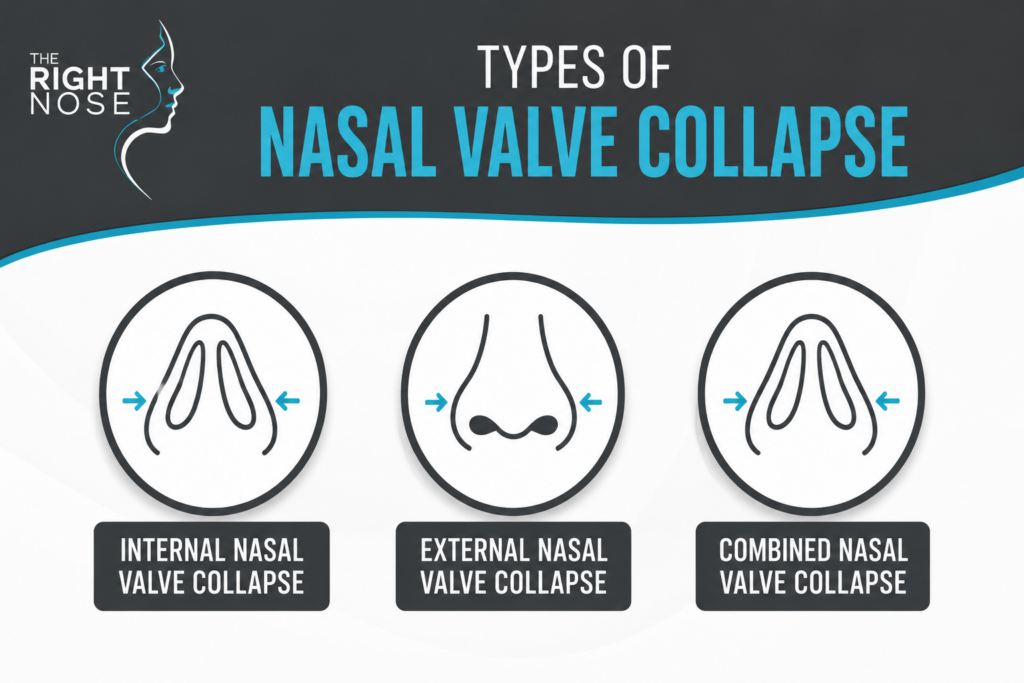
Types of Nasal Valve Collapse
Doctors generally classify the condition into two main types.
Internal Nasal Valve Collapse
The area affected is the narrow angle that sits inside the nose between the septum and the upper lateral cartilage. It is the most common form and often causes difficulty breathing during inhalation.
External Nasal Valve Collapse
This occurs closer to the nostril opening when the tissues supporting the nostril become weak and collapse inward while breathing.
Some patients experience both types simultaneously, requiring a more comprehensive treatment approach.
What causes Nasal Valve Collapse?
Several factors can weaken or narrow the nasal valve.
Common causes include:
- Age-related weakening of the nasal cartilage
- Facial trauma or a broken nose
- Congenital structural differences are present from birth
- Significant deviation of the nasal septum
- Long-term inflammation affecting the nasal tissues
- Loss of cartilage support following injury
Previous rhinoplasty, particularly when excessive cartilage has been removed or the nose has been narrowed too much, can weaken the nasal sidewalls and lead to internal or external nasal valve collapse. This is one of the most common reasons patients seek revision rhinoplasty to restore both breathing and nasal support.
Can Rhinoplasty cause Nasal Valve Collapse?
Yes. While rhinoplasty can improve both appearance and function, removing too much cartilage or excessively narrowing the nasal bridge may reduce the structural support of the nasal valves. This can result in alar (external nasal valve) collapse, where the nostrils move inward during breathing and restrict airflow.
Patients may notice that breathing becomes more difficult months or even years after cosmetic nose surgery. In these situations, revision rhinoplasty combined with functional nasal valve reconstruction can restore both nasal support and comfortable breathing.
Common symptoms of Nasal Valve Collapse
The symptoms of nasal valve collapse often develop gradually and may initially be mistaken for allergies or chronic sinus problems.
Typical symptoms include:
- Persistent nasal blockage on one or both sides
- Difficulty breathing through the nose, particularly during exercise
- Feeling that the nose “closes” when taking a deep breath
- Noisy breathing
- Mouth breathing, especially during sleep
- Snoring
- Poor sleep quality
- Reduced exercise tolerance
- Feeling temporary improvement when gently pulling the cheek sideways (known as the Cottle manoeuvre)
Many patients notice that nasal sprays provide little or no lasting relief because the problem is structural rather than inflammatory.
How Nasal Valve Collapse differs from other causes of nasal blockage?
Condition | Main cause | Typical symptoms | Response to nasal spray |
|---|---|---|---|
Nasal valve collapse | Weak or narrowed nasal valve | Difficulty breathing in, collapsing nostril | Usually minimal improvement |
Deviated septum | Crooked nasal septum | One-sided blockage | Limited improvement |
Allergic rhinitis | Inflammation from allergens | Sneezing, itching, runny nose | Often improves |
Nasal polyps | Benign tissue growth | Blocked nose, reduced smell | May improve temporarily with steroid sprays |
Because symptoms often overlap, a specialist examination is the best way to identify the true cause.
How is Nasal Valve Collapse diagnosed?
A proper diagnosis involves more than simply looking inside the nose.
During your consultation, Dr Levente Deak will begin by discussing your symptoms, previous nasal injuries, surgeries, and overall medical history.
The examination may include:
Physical examinationThe shape and strength of the nasal structures are carefully assessed while you breathe normally and deeply. | Cottle ManoeuvreYour doctor gently pulls the cheek sideways to widen the nasal valve. If breathing immediately improves, this may indicate nasal valve weakness. |
Nasal endoscopyA thin flexible camera allows detailed examination of the internal nasal structures to identify narrowing or other contributing conditions. | Functional assessmentYour specialist evaluates airflow while observing how the nasal walls move during breathing. |
In selected cases, imaging studies such as CT scans may be recommended if additional structural abnormalities or sinus disease are suspected.
Accurate diagnosis is important because treating allergies or a deviated septum alone will not resolve symptoms caused by nasal valve collapse.
Why is Nasal Valve Collapse common in revision Rhinoplasty?
One of the most frequent reasons for revision rhinoplasty is persistent nasal obstruction caused by an unrecognised or untreated nasal valve collapse. During a revision procedure, the surgeon not only improves the appearance of the nose but also restores its internal support to improve airflow.
For many patients, breathing problems occur because the nose has become too narrow following previous surgery. Rebuilding the nasal framework helps restore normal function while preserving a natural appearance.
Treatment options
Symptom severity, the underlying cause, and how much the condition is disrupting daily life all play a role in determining the right course of treatment.
Non-surgical management
Mild cases may improve with supportive measures, including:
- External nasal dilator strips
- Internal nasal dilators
- Treating associated allergies or inflammation
- Avoiding factors that worsen nasal swelling
These options can take the edge off symptoms temporarily, but they rarely do anything to address the structural weakness that lies underneath.
Nasal Valve Collapse surgery
When symptoms significantly affect breathing or conservative treatments are unsuccessful, nasal valve collapse surgery may be recommended.
The procedure focuses on strengthening or widening the weakened area of the nasal valve rather than simply removing tissue.
Depending on the underlying cause, nasal valve collapse surgery may include one or more reconstructive techniques:
- Spreader grafts – Small cartilage grafts placed between the septum and upper lateral cartilage to widen the internal nasal valve and improve airflow.
- Alar batten grafts – Used to reinforce weakened nostrils and prevent the external nasal valve from collapsing during breathing.
- Septoplasty – Corrects a deviated septum when present in the patient.
- Turbinate reduction (turbinoplasty) – Reduces enlarged turbinates that may contribute to nasal blockage.
- Functional or revision rhinoplasty – Restores both breathing and structural support in patients with previous nasal surgery.
The primary goal of nasal valve collapse surgery is to improve airflow while maintaining the natural appearance of the nose whenever possible.
Why are spreader grafts used?
Spreader grafts are one of the most effective techniques for treating internal nasal valve collapse. They are usually created from the patient’s own cartilage and positioned between the septum and the upper lateral cartilage to widen the narrowest part of the nasal airway.
By strengthening the middle portion of the nose, spreader grafts improve airflow, reduce airway collapse during breathing and help maintain the natural shape of the nose. They are commonly used during both primary and revision rhinoplasty.
What to expect during recovery?
Many patients ask about nasal valve collapse surgery recovery time before deciding on treatment.
Recovery varies depending on the complexity of the procedure and whether additional surgery is performed.
First week- Swelling, congestion and mild discomfort
2-3 weeks- Most bruising and swelling improve
4-6 weeks- Breathing gradually becomes easier
Several months- Final healing and stabilisation of nasal tissues
Most people can return to office-based work within one to two weeks, although strenuous exercise should usually be avoided for several weeks.
Following your surgeon’s aftercare advice helps support healing and optimise results.
When should you see an ENT specialist?
Persistent nasal blockage should not simply be accepted as “normal.”
Arrange an assessment if you experience:
- Ongoing difficulty breathing through your nose
- Symptoms that do not improve with allergy treatment
- Breathing problems after nasal injury
- Persistent obstruction following rhinoplasty
- Sleep disturbance caused by nasal blockage
Early diagnosis can prevent prolonged symptoms and help identify the most effective treatment.
A better understanding leads to better breathing
Living with chronic nasal obstruction can affect sleep, exercise, concentration, and overall well-being. Fortunately, identifying nasal valve collapse is often the first step towards meaningful improvement.
If conservative measures are not enough, nasal valve collapse surgery can restore airflow by addressing the structural cause of the problem rather than simply masking symptoms.
At Dr Levente Deak’s clinic, every treatment plan is tailored to the individual after a detailed assessment, ensuring patients receive the most appropriate care for long-term breathing improvement.
Some Quick FAQs
Common symptoms include persistent nasal blockage, difficulty breathing through the nose, snoring and a feeling that the nostril collapses when inhaling.
Diagnosis involves a specialist examination, nasal endoscopy, breathing assessment and tests such as the Cottle manoeuvre to evaluate nasal valve function.
For most patients, normal daily activities can resume within one to two weeks, while the body continues to heal fully over the months that follow.
In many patients, nasal valve collapse surgery provides long-lasting improvement by strengthening the weakened nasal structures.
Nasal dilators or managing associated inflammation can make a difference in milder cases, structural collapse and complex cases generally needs surgical correction to bring real and lasting results.
Yes. Some people naturally have a narrow nasal framework, while others develop one after rhinoplasty. When the bridge of the nose is narrowed excessively or too much cartilage is removed, the internal airway becomes smaller and less stable.
Nasal valve collapse occurs when the narrowest section of the nose becomes weak or too narrow, restricting the amount of air that passes through during breathing. Rather than remaining open as you inhale, the walls of the nose partially collapse inward, making it difficult to breathe comfortably.
Despite its size, the nasal valve is a vital structure when it comes to regulating airflow, accounting for the majority of resistance within the nasal airway. Even minor structural changes can have a noticeable impact on breathing.
Nasal valve collapse may affect one side or both sides of the nose and can develop gradually or after an injury or previous nasal surgery.
Research suggests that nasal valve dysfunction contributes to nasal obstruction in a significant proportion of patients seeking treatment for chronic nasal blockage. It is also recognised as an important cause of persistent breathing difficulties after rhinoplasty if not identified beforehand.
Nasal valve collapse occurs when the narrowest section of the nose becomes weak or too narrow, restricting the amount of air that passes through during breathing. Rather than remaining open as you inhale, the walls of the nose partially collapse inward, making it difficult to breathe comfortably.
Despite its size, the nasal valve is a vital structure when it comes to regulating airflow, accounting for the majority of resistance within the nasal airway. Even minor structural changes can have a noticeable impact on breathing.
Nasal valve collapse may affect one side or both sides of the nose and can develop gradually or after an injury or previous nasal surgery.
Research suggests that nasal valve dysfunction contributes to nasal obstruction in a significant proportion of patients seeking treatment for chronic nasal blockage. It is also recognised as an important cause of persistent breathing difficulties after rhinoplasty if not identified beforehand.
The distinctiveness of ethnic rhinoplasty lies in a surgeon’s ability to understand the unique nasal characteristics of different ethnicities and customize the procedure to reflect the patient’s cultural identity and aesthetic goals. Dr. Levente prioritizes three critical aspects to ensure a balanced and visually appealing outcome:
- Analyzing overall facial structure and proportions.
- Assessing the nasal skin, cartilage, and bone structures.
- Recognizing the significance of the patient’s cultural background.
Ethnic rhinoplasty is more than just a cosmetic procedure; it’s an art form that respects and enhances cultural identity. Trust Dr. Levente Deak to deliver results that celebrate your unique beauty.
How is Nasal Valve Collapse diagnosed?
A proper diagnosis involves more than simply looking inside the nose.
During your consultation, Dr Levente Deak will begin by discussing your symptoms, previous nasal injuries, surgeries, and overall medical history.
The examination may include:
Physical examinationThe shape and strength of the nasal structures are carefully assessed while you breathe normally and deeply. | Cottle ManoeuvreYour doctor gently pulls the cheek sideways to widen the nasal valve. If breathing immediately improves, this may indicate nasal valve weakness. |
Nasal endoscopyA thin flexible camera allows detailed examination of the internal nasal structures to identify narrowing or other contributing conditions. | Functional assessmentYour specialist evaluates airflow while observing how the nasal walls move during breathing. |
In selected cases, imaging studies such as CT scans may be recommended if additional structural abnormalities or sinus disease are suspected.
Accurate diagnosis is important because treating allergies or a deviated septum alone will not resolve symptoms caused by nasal valve collapse.

Meet the Author
Dr. Levente Deak is a European Board-Certified ENT Surgeon and a USA and EU Dual Board-Certified Facial Plastic Surgeon based in Dubai. With over 20 years of surgical experience focused exclusively on the face, he specialises in rhinoplasty, blepharoplasty, facial rejuvenation, and nasal airway correction. An active member of the Royal College of Surgeons and the European Academy of Facial Plastic Surgery (EAFPS), Dr. Levente is known for his precision-driven, minimally invasive approach. His guiding philosophy, that every nose must be tailored to the individual, shapes every procedure he performs at The Right Nose clinic.
Medical Disclaimer
The content on this blog is for informational purposes only and does not constitute medical advice, diagnosis, or treatment. Individual results may vary. Always consult Dr. Levente Deak or a qualified healthcare provider before pursuing any surgical or non-surgical procedure.