






Get Natural Results With Preservation Rhinoplasty in Dubai
Get Natural Results With Preservation Rhinoplasty in Dubai
Choosing to reshape your nose is a personal decision, and for many people, the goal isn’t to look completely different, it’s to feel more confident while still looking like themselves.
This approach, known as preservation rhinoplasty, focuses on refining the nose while maintaining its natural support. Instead of removing large amounts of bone and cartilage, the surgeon carefully reshapes existing structures to achieve balanced, subtle results. For suitable candidates, this can lead to a preservation rhinoplasty natural result that enhances facial harmony without looking overdone.
At his Dubai practice, Dr Levente Deak takes a personalised approach to every rhinoplasty procedure. By carefully assessing your facial proportions, nasal anatomy, and treatment goals, he recommends the technique that is most appropriate for you. If you’re considering nose reshaping, understanding how preservation rhinoplasty works is the first step towards making an informed decision.
What is Rhinoplasty?
Rhinoplasty is a surgical procedure that changes the shape or structure of the nose. It’s commonly performed to improve appearance, but rhinoplasty can also address structural problems that get in the way of breathing, like a deviated septum or nasal obstruction.
People choose rhinoplasty for many reasons, including:
- A drooping or bulky nasal tip
- Asymmetry
- A nose that appears too large or too small for the face
- Breathing difficulties caused by structural issues
- Changes following an injury
Rather than creating a “perfect” nose, modern rhinoplasty aims to achieve a better balance between the nose and the rest of the face while preserving normal function wherever possible.
What does research suggest? According to the American Society of Plastic Surgeons, rhinoplasty is one of the most commonly performed facial cosmetic procedures worldwide, reflecting its long-standing role in both cosmetic and functional facial surgery. |
What is Preservation Rhinoplasty?
Traditional rhinoplasty has helped countless patients achieve excellent results, but surgical techniques have continued to evolve. Today, many surgeons use preservation rhinoplasty for carefully selected patients because it focuses on working with the nose’s natural anatomy rather than removing and rebuilding it.
In simple terms, preservation rhinoplasty is designed to keep as much of the existing bone, cartilage, and supporting tissues intact as possible. Instead of shaving down the bridge of the nose from the outside, the underlying structures are adjusted so the bridge can be lowered while maintaining its smooth natural contour.
The aim is to create a nose that looks refined but still suits your face. Rather than making dramatic changes, this technique focuses on subtle improvements that maintain your unique features.
For many patients, this approach offers a preservation rhinoplasty natural result, where friends and family notice you look refreshed without immediately recognising you’ve had surgery.
Understanding Dorsal Preservation Rhinoplasty
You may come across the term dorsal preservation rhinoplasty while researching nose reshaping. The “dorsum” simply refers to the bridge of the nose.
In traditional rhinoplasty, a hump on the bridge is usually removed from the top before the nose is reshaped. With dorsal preservation rhinoplasty, the bridge is lowered by adjusting the structures beneath it, allowing the natural surface of the nose to remain largely intact.
This approach may offer several advantages for suitable patients, including:
- Maintaining the natural contour of the bridge
- Preserving more of the nose’s support structures
- Creating smoother transitions between the forehead and nasal tip
- Reducing the likelihood of visible irregularities along the bridge
- Supporting a preservation rhinoplasty natural result that looks balanced and in harmony with the rest of the face
The decision to use this technique depends on your individual anatomy and is made after a detailed assessment by an experienced facial plastic surgeon.
How is Preservation Rhinoplasty Different from traditional Rhinoplasty?
Although the aim of both procedures is to improve the functioning and appearance of the nose, they use different surgical approaches.
Feature | Preservation Rhinoplasty | Traditional Rhinoplasty |
Surgical approach | Preserves much of the natural bone and cartilage | Removes and reshapes more of the nasal framework |
Bridge treatment | Lowers the bridge while maintaining its natural contour | Removes the hump and reconstructs the bridge if needed |
Tissue disruption | Less disruption to healthy structures where appropriate | May involve more structural modification |
Main goal | Natural refinement while preserving facial character | Reshaping tailored to cosmetic or functional needs |
Best suited for | Selected patients with suitable nasal anatomy | A wider range of cosmetic and reconstructive concerns |
Neither approach is better than the other for every patient. The accurate choice depends on your facial structure, the changes you wish to achieve, and whether functional concerns also need to be addressed. During your consultation, Dr Levente Deak carefully evaluates these important factors before recommending the most appropriate treatment plan.
Who is a good candidate for Preservation Rhinoplasty?
While preservation rhinoplasty offers excellent results for many patients, it isn’t the right option for everyone. The technique works best when the existing nasal framework can be refined rather than extensively rebuilt.
You may be a suitable candidate if you:
- Have a mild to moderate hump on the bridge of the nose
- Want subtle, natural-looking changes rather than a dramatic transformation
- Are unhappy with the size or shape of your nose but have good overall nasal structure
- Have realistic expectations about the outcome
Patients with severe nasal deformities, significant trauma, or previous complex rhinoplasty may require a different surgical approach. During your consultation, Dr Levente Deak will assess your nasal anatomy and discuss which technique is most suitable for your needs.
Your consultation and assessment
A successful rhinoplasty begins long before the operation itself. The consultation matters, it’s where your concerns are properly understood, your nose is carefully evaluated, and a treatment plan that fits your face is put together.
During your appointment, Dr Levente Deak will typically:
- Discuss your medical history and any previous nasal injuries or surgeries.
- Examine the external shape and internal structure of your nose.
- Assess your breathing and identify any functional concerns.
- Take clinical photographs for surgical planning.
- Talk through your expectations and explain what can realistically be achieved.
This personalised assessment helps ensure that the chosen approach supports both facial harmony and nasal function.
What happens during the procedure?
The exact steps vary depending on your individual needs, but the procedure generally follows a similar process.
After you are placed under general anaesthetic, carefully planned incisions are made to access the nasal structures. Rather than removing large sections of bone and cartilage, the surgeon reshapes and repositions the underlying framework while preserving as much of the natural anatomy as possible.
If required, the nasal tip can also be refined to improve overall balance. The incisions are closed once the right shape has been achieved, and a small splint is placed over the nose to keep it protected as healing begins.
Most procedures take between two and three hours, although this depends on the complexity of the surgery.
Benefits of Preservation Rhinoplasty natural result
One of the main reasons patients choose preservation techniques is the possibility of achieving subtle improvements that look natural. A well-planned procedure focuses on enhancing your existing features rather than creating a completely different nose.
Some potential benefits include:
- A preservation rhinoplasty natural result that complements your facial features
- Preservation of important nasal support structures
- Smooth, balanced contours along the bridge
- Reduced disruption to healthy tissues
- Long-lasting aesthetic and functional improvements when appropriate
Like all surgical procedures, rhinoplasty also carries some risks. These may include bleeding, infection, swelling, bruising, temporary numbness, breathing changes, asymmetry, or the need for further surgery. Although serious complications are uncommon, understanding these risks is an important part of making an informed decision.
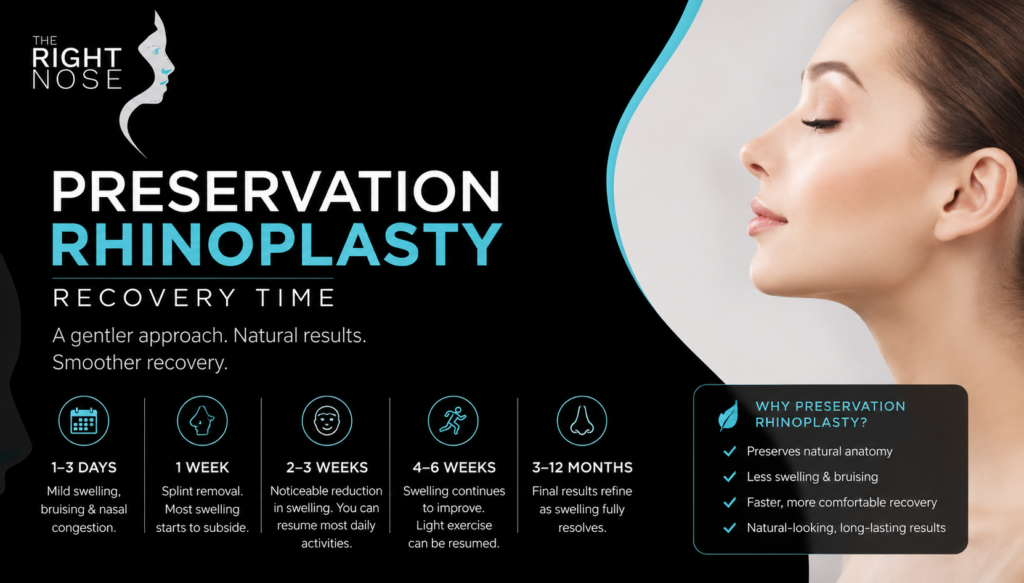
What is the Preservation Rhinoplasty recovery time?
The preservation rhinoplasty recovery time varies from person to person, depending on the extent of the procedure and individual healing. Swelling is usually most noticeable during the first week before gradually improving over the following months.
Recovery timeline
Time After Surgery | What to Expect |
First week | Swelling, bruising and nasal congestion are common. A splint is worn to protect the nose. |
7–10 days | The splint is usually removed, and many patients return to desk-based work. |
2–4 weeks | Most bruising settles, and everyday activities can gradually resume. |
Around 3 months | Much of the swelling has reduced, and the new shape becomes more noticeable. |
Up to 12 months | The nose continues to refine as healing progresses, revealing the final result. |
Tips for a smooth recovery
Although healing takes time, following your surgeon’s advice can make recovery more comfortable.
During the first few weeks, it helps to:
- Sleep with your head slightly elevated to reduce swelling.
- Avoid strenuous exercise until your surgeon says it is safe.
- Protect your nose from accidental knocks or pressure.
- Follow your prescribed medication and aftercare instructions.
- Attend all follow-up appointments so your healing can be monitored.
Being patient is just as important as following the aftercare advice. While you’ll notice changes early on, the final result develops gradually as swelling settles.
A natural approach to nose reshaping
For those after a more refined nose that doesn’t look like it’s been visibly altered, preservation techniques could be well worth considering. By working with your natural anatomy rather than removing large amounts of tissue, this modern approach aims to achieve a preservation rhinoplasty natural result that enhances facial harmony while maintaining your unique features.
At his Dubai practice, Dr Levente Deak takes the time to understand every patient’s goals before recommending the most suitable treatment.
With careful planning and advanced surgical techniques, the focus is always on achieving balanced, natural-looking results that complement your face rather than change who you are.
Some Quick FAQs
That depends on nasal anatomy, treatment goals, and whether functional correction is needed all play a role in determining which technique is the right fit.
Dorsal preservation rhinoplasty reshapes the bridge of the nose while preserving its natural outer contour, helping create smoother and more natural-looking results.
Most people return to office-based work within 7–10 days, but complete healing and refinement of the nose can take up to a year.
When carefully planned, the goal is to achieve a preservation rhinoplasty natural result that enhances your features without making your nose look overcorrected.
Yes, and it’s a meaningful benefit, addressing structural problems that affect airflow during surgery often leaves patients with improved nasal function as well as the cosmetic enhancement they were looking for.