







Complete Guide to Endoscopic Facelift Recovery: What to Expect Week-by-Week
Complete Guide to Endoscopic Facelift Recovery: What to Expect Week-by-Week
Will I be swollen for weeks? When will I look like myself again after an endoscopic facelift? These are the first questions patients ask after a facial rejuvenation. A successful facelift is not about the procedure alone but understanding the healing journey as well.
The modern endoscopic facelift achieves natural-looking facial rejuvenation through smaller incisions and precise tissue repositioning. During endoscopic facelift recovery, many patients experience a smoother healing process with less visible scarring and a quicker return to daily life.
Dr Levente Deak, a European Board-Certified ENT Surgeon and Dual (USA, EU) Board-Certified Facial Plastic Surgeon, provides 20 years of dedicated expertise to facial and nasal surgery. Dr Levente focuses on achieving natural-looking results while supporting patients through every stage of recovery with clear, expert guidance.
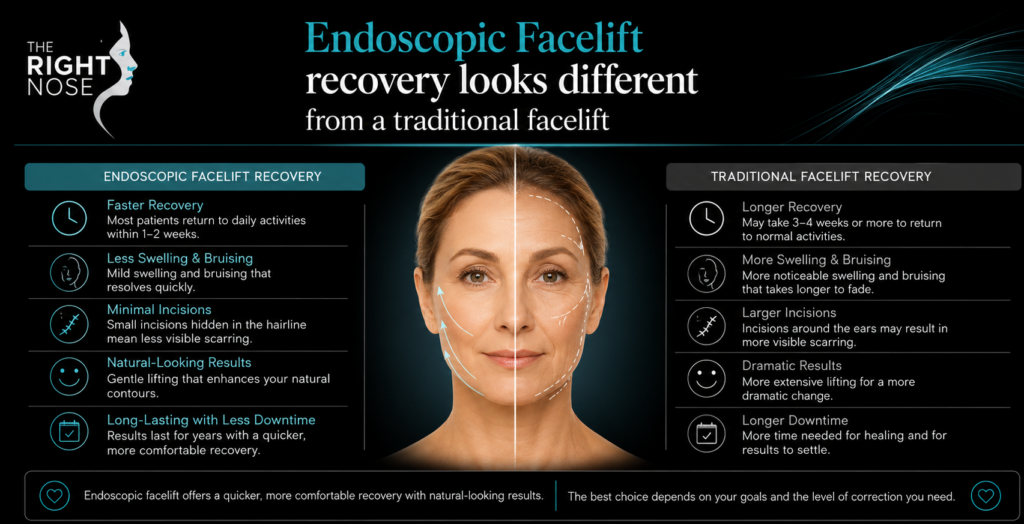
Why Endoscopic Facelift recovery looks different from a traditional facelift?
An endoscopic facelift uses specialised camera-assisted technology that allows the surgeon to work through smaller incisions while carefully repositioning deeper facial tissues. Rather than focusing solely on tightening the skin, the procedure addresses underlying structures that contribute to facial ageing.
This approach offers several advantages during endoscopic facelift recovery, including:
- Smaller, more discreet incisions
- Reduced tissue trauma
- Less swelling and bruising during the early recovery period
- Minimal visible scarring
- A more natural-looking result
- May have reduced downtime compared to more involved facelift operations
However, it is important to remember that recovery is influenced by several factors, including:
- Age and skin quality
- Overall health
- Smoking status
- Surgical complexity
- Adherence to aftercare instructions
Since each patient is different, the endoscopic facelift recovery time may differ, but most patients begin to see meaningful results week by week.
Endoscopic Facelift recovery time: A quick overview
Before diving into the details, here’s a general timeline of what many patients experience:
Recovery Stage | What You May Notice |
Days 1–3 | Swelling, bruising, tightness |
Week 1 | Noticeable improvement, minor bruising concealable with make-up, many patients return to work |
Week 2 | Significant reduction in bruising |
Weeks 3–4 | Return to many social activities |
Months 2–3 | Facial contours become more refined |
Months 3–6 | Final results continue to emerge |
Understanding this timeline helps create realistic expectations and reduces unnecessary worry during the healing process.
Your Endoscopic Facelift recovery time, week by week
Recovery isn’t a single event; it’s a gradual process with fairly predictable stages. Here’s a realistic breakdown of endoscopic facelift healing time, from surgery day through to final results.
Days 1–3: What to expect after Endoscopic Facelift Surgery
The first few days are focused on rest, recovery, and protecting the surgical area.
Many patients are pleasantly surprised that discomfort is often manageable and typically described as tightness or pressure rather than severe pain.
Common symptoms during the first 72 hours
- Mild to moderate swelling
- Bruising around the cheeks and temples
- Tightness across the treated areas
- Temporary numbness
- Mild fatigue
If you’re wondering what to expect after endoscopic facelift surgery, swelling is usually the most noticeable aspect of early recovery. This is a normal part of the body’s healing response.
Supporting recovery during the first week
To encourage comfortable healing, patients may be advised to:
- Wear compression support as instructed, including at home and during sleep
- Sleep with the head elevated to help minimise swelling
- Avoid pressure on the treated areas
- Follow personalised post-operative instructions from Dr Levente Deak
These simple measures can significantly influence your overall recovery experience.
Week 1: Noticeable improvement begins
The first week is an important milestone in the recovery journey. By around seven days after surgery, many patients begin to look and feel significantly better, with swelling and bruising gradually improving.
During this stage, many patients feel comfortable returning to work, depending on their individual healing progress and the type of work they do.
What patients may notice during the first week:
- Reduced swelling compared with the first few days
- Bruising gradually improving
- Less facial tightness
- Better comfort during daily activities
- Increased confidence as the face begins to settle
Minor bruising can often be concealed with make-up once approved by your surgeon, allowing many patients to feel more comfortable returning to their normal routines.
Can you return to normal activities?
Many patients gradually return to normal daily activities during the first week, including:
- Taking short walks
- Returning to office-based work (depending on comfort level)
- Performing light household tasks
However, strenuous exercise and heavy physical activity should only be resumed when cleared by Dr Levente Deak.
Week 2: A significant turning point in Endoscopic Facelift healing time
For many patients, week two marks one of the most encouraging stages of recovery.
Visible bruising often improves dramatically, and facial features become more refined.
Signs of progress
- Reduced swelling
- Less facial tightness
- Improved comfort
- Greater confidence when socialising
- More natural facial contours becoming visible
This stage often provides reassurance that healing is progressing as expected.
When discussing endoscopic facelift healing time, it is important to understand that although external improvements are noticeable, deeper tissues are still recovering.
Weeks 3–4: Looking more like yourself again
By the third and fourth weeks, many patients feel significantly more comfortable in social settings.
Family, friends, and colleagues may notice that you look refreshed or well-rested without immediately recognising that you’ve had surgery.
What gets better in this phase?
- The facial contours look more natural
- Residual bruising keeps fading away.
- The swelling decreases in visibility
- Facial movement becomes more normal.
What is still normal?
In this phase, some patients suffer from:
- Mild numbness
- Temporary tightness
- Some pockets of remaining swelling
- Minimal sensitivity at incisions
These symptoms will usually improve over time as healing progresses.
Months 2–3: Refinement and definition
One of the most rewarding aspects of recovery occurs during the second and third months.
As swelling continues to settle, the benefits of surgery become increasingly apparent.
What you may notice
- Improved midface support
- Better definition along the jawline
- Smoother facial contours
- Enhanced facial balance
- Natural-looking rejuvenation
This is often when patients begin to fully appreciate the subtle yet transformative nature of an endoscopic facelift.
Although most visible healing has occurred, endoscopic facelift healing time continues beneath the surface as tissues mature and adapt.
Months 3–6: Final stages of Endoscopic Facelift recovery
Healing does not stop after the first few weeks.
Over the following months, tissues continue to soften and settle into their final position.
When will you see your final result?
While most patients notice significant improvement within the first few weeks, subtle refinement continues as swelling settles and tissues mature over the following months.
This gradual progression contributes to the natural appearance that many patients desire.
The complete endoscopic facelift recovery time is therefore best viewed as a journey rather than a single milestone.
Healing in Dubai's climate: What to expect after Endoscopic Facelift Surgery in a hot, sunny city
Dubai’s heat, humidity and near-constant sunshine genuinely affect how facial skin heals, a detail most generic recovery guides overlook entirely.
- Protect healing skin from sun exposure with high SPF protection, a hat, and limited direct sun exposure to support healthy healing and reduce the risk of pigmentation changes.
- Temporary swelling may fluctuate due to shifts between outdoor heat and air-conditioned environments. Staying well hydrated can help.
- Patients travelling to Dubai for surgery should plan to remain in the city for at least 1 to 2 weeks to allow for follow-up appointments and early recovery.
- Beaches, swimming pools, and saunas should be avoided until your incisions have fully healed and your surgeon advises it is safe to resume these activities.
7 Practical Endoscopic Facelift Recovery Tips
Following the right aftercare routine can make a meaningful difference during recovery.
Use compression support as advised and sleep with your head elevated – a couple of extra pillows reduce fluid build-up more effectively than most people expect | Stick to a soft diet for the first few days to limit unnecessary facial movement. | Stay hydrated, aiming for around 2 to 3 litres of water daily, especially important in Dubai’s dry heat. |
Avoid blood thinners, including aspirin, certain supplements and alcohol, for two weeks on either side of surgery | Hold off on strenuous exercise and heavy lifting for around four to six weeks | Resist touching or checking incisions constantly – gentle, infrequent cleansing as instructed is enough |
Keep every follow-up appointment – they’re how Dr Deak tracks your individual healing and adjusts advice early if needed |
Lifestyle choices that support healing
Recovery is not only about surgical care – daily habits also influence healing.
Patients are encouraged to:
- Avoid alcohol during the early recovery period, as it may increase swelling and affect healing
- Follow a balanced, anti-inflammatory diet rich in:
- Fresh fruits and vegetables
- Protein-rich foods
- Omega-3 sources
- Adequate hydration
What can delay Endoscopic Facelift Recovery?
Several factors can prolong recovery or affect healing quality.
These include:
- Smoking
- Poor nutrition
- Excessive alcohol consumption
- Returning to exercise too soon
- Ignoring post-operative instructions
- Missing follow-up appointments
Being proactive about recovery can help minimise complications and support long-term results.
When to contact Dr Levente Deak?
Most of the recovery is straightforward, but get in touch with Dr Deak’s team promptly if you notice:
- Suddenly, one-sided swelling well beyond what’s expected
- Signs of infection, such as increasing redness, warmth or discharge
- Fever, or pain that worsens rather than improves after the first few days
These signs are uncommon, but prompt attention makes all the difference.
Why patients trust Dr Levente Deak for Endoscopic Facelift Recovery ?
Dr Levente Deak is known for his exquisite skills in facial plastic surgery, blending state-of-the-art surgical procedures with an artistic aesthetic of facial symmetry.
His philosophy is based on providing a beautiful, natural look that enhances people, not changes them. Dr Levente’s goal is to achieve rejuvenation without unnecessary tissue trauma through the use of precise endoscopic techniques and treatment planning.
Patients value his commitment to:
Natural, age-appropriate results | Advanced facial rejuvenation techniques |
Attention to facial harmony and proportions | Comprehensive support throughout recovery |
Ready for a confident and well-guided recovery?
Understanding what to expect after endoscopic facelift surgery can make the recovery journey far less stressful and far more predictable.
With a clear timeline, sensible endoscopic facelift recovery tips, and the guidance of a Dual Board-Certified Facial Plastic Surgeon, most patients move through each stage with confidence rather than anxiety.
Book your consultation with Dr Levente Deak to discuss your personalised recovery plans.
Some Quick FAQs
Many patients notice visible improvement within the first week as swelling and bruising begin to settle. Recovery continues gradually, with facial contours becoming more refined over the following months.
Light walking is usually encouraged early in recovery, but more strenuous activities should only be resumed with your surgeon’s approval.
Swelling, bruising, tightness, and temporary numbness are all common during the early recovery period. These symptoms typically improve week by week.
Endoscopic facelift uses smaller incisions and precise tissue repositioning, so patients experience a smoother recovery compared to traditional facelift.
Most swelling improves significantly within the first few weeks, although minor residual swelling can take several months to fully resolve.
Most patients begin wearing make-up once the incisions have healed adequately and their surgeon has given approval. This often occurs within one to two weeks, although timelines vary between individuals.